The following is an important guest article by Dr Scott McLachlan. A pdf version can be found here.
David
Fuller: An example of how unqualified ‘journalists’ attempt to discredit and
silence anybody publishing COVID-19 research that challenges the ‘official
narrative’
Scott McLachlan
Introduction
On 12 August 2021 David Fuller wrote a long article
attempting to discredit the work of those who have challenged the ‘official’
narrative on the safety and effectiveness of COVID-19 vaccines and alternative
treatments. His article claims to be a detailed investigation into two
independent journalists who produce the Dark Horse podcast
- Bret Weinstein and Heather Heying, as well as several of their on-air guests.
However, the article quickly descends into a polemic aimed at others including Dr Pierre Kory, myself and
co-authors of this paper. As I will show here, when challenged about the personal
attacks against me in the article, Fuller claimed he had never heard of me; when it was pointed out to him that his article contained an extensive attack against me he then tried to extricate himself from this by saying that he was not responsible
for writing it - despite him being the sole named author.
Here I expand on three Twitter threads I posted on
August 19,
August 20,
and August 22 in
response to Fuller’s hit piece.
Who is David
Fuller?
David Fuller, is a “writer and journalist”
who produces documentaries mainly for Channel 4 and the BBC.
Fuller started his own website called Rebel Wisdom
in 2018, which he describes as a platform for philosophical,
transformational and cultural topics.
The website asserts that he blogs “frequently about politics, and the inner
world”, but the link provided on that statement (https://medium.com/@davidfuller)
takes you to the page shown in Fig. 1. We might be given to wonder who Samuel
Hinton is and why a URL containing David Fuller’s name lands on an empty
account for Mr Hinton - but this isn’t the only incongruity we will see in the writings
and claims of David Fuller.
Figure 1:
The @davidfuller page on Medium
Fuller claims to be engaged in a self-mediated
truth-finding exercise he calls SenseMaking. However, from the outset
his efforts are no different to those who have recently self-appointed themselves
as ‘fact checkers’ - journalists often armed with little more
qualification than a liberal arts or English literature degree who, for no
other reason than the fact that they have found a platform, have decided they
know more than clinicians, researchers and professors with far more appropriate
qualifications in medicine, health science, health informatics, health law,
mathematics or statistics. Often, these SenseMaking ‘fact checkers’
do little more than cross-link each other’s articles as ‘supporting evidence’
to debunk, discredit or deny what can sometimes be rigorously researched
findings that run counter to the mainstream media’s COVID-19 narrative. And
when they have nothing legitimate to support their views, ‘fact checkers’
like Fuller resort to indirect insults by linking to statements made by
anonymous social media posters (Fig. 2 & 3) like uberfeminist
described as the nastiest and vilest around (Fig. 4), which
Fuller happily cites as though they are authoritative sources.

Figure 2:
A typical post by the anonymous Twitter account @UberFeminist (UF)
Figure 3:
A post in the @UberFeminist (UF) thread linked by David Fuller in his article
Figure 4:
One of many posts describing @UberFeminist (UF) and another linked Twitter
account (Yuri) cited in Fuller's article
Fuller’s claims
about our work
Fuller’s claims relate primarily to this article
in which I was the lead author with five other named co-authors. The article
was a detailed analysis of a subset of the initial publicly available data (from
VAERS) on vaccine adverse reaction. The article currently has over 89,000 reads
on ResearchGate.
Media narrative, fact checking and Tucker
Carlson in the ‘lead in’
Fuller opens his criticism of our work with the
statement:
There
hasn’t been a systematic response to the paper’s more detailed claims, but
there are reasons to be suspicious.
He follows this imputation, presumably to
demonstrate one of the alleged reasons, by stating:
Much
of the lead-in to the paper is highly opinionated, a polemic against ‘the media
narrative and fact-checking’ that mentions Tucker Carlson and several tweets
the authors find objectionable.
This reproachful claim is deceptive and
misleading.
First, nowhere in the ‘lead-in’ to our article do
we mention Tucker Carlson. Nor do we discuss the media narrative or
fact checkers. While these terms do arise in our paper, they only occur
in the final paragraphs of the work. They occur in that area most academic
works regard as the discussion, and have absolutely no bearing on the
method or results already presented in the leading sections of the paper.
The characterisation by Fuller that we discuss these
items in a manner highly opinionated and as a polemic is also wrong.
Our crime, in Fuller’s estimation, appears to be that we lift the veil on who
exactly the so-called fact checkers really are. That the vast majority,
like him, are journalists lacking relevant qualifications in the often highly
technical, clinical and contested domains they claim to be fact checking.
We make very clear that the reason we mention Carlson is because he is the only
major TV presenter to have asked the following obvious questions about the same
VAERS data we were analysing:
- How many people have died
after taking [this medication]?
- What are the potential
risks from taking [this medication]?
- What do we really know
about the potential risks from taking [this medication]?
We simply pointed out that these were appropriate
questions to ask and did not comment on anything else said in Carlson’s piece
to camera.
Our ‘credentials’
In addition to trying to discredit our research of
the basis of what he assumes our political beliefs to be, Fuller impugns our
credentials. He writes:
The
paper is a preprint... and it’s authors don’t seem to have the best
credentials, either.
He doesn’t support this claim either directly in
its own paragraph, or even in the next paragraph. He leaves this claim hanging
as if presenting knowledge that is either notorious or a fait accompli.
For the record, before gaining my PhD in computer
science and health informatics I gained separate Masters degrees in Science and
Law, which in turn had followed previous undergraduate study in health
(clinical nursing), computer and information sciences. I am extensively
published in the area of health informatics and health data analysis. These
would seem to be relevant qualifications for someone analysing and commenting
on what is a large health reporting dataset.
My co-authors hold a variety of similarly relevant
top-shelf qualifications. Fenton is world-renowned expert in probabilistic risk
assessment
and is Professor of Risk and Information Management at Queen Mary University of
London (QMUL). Osman holds a PhD in Experimental Psychology and is currently a
Reader in Experimental Psychology at QMUL. Dube holds a PhD in Computer Science
and has researched and published extensively in health informatics and the
privacy and ethical issues of using patient data. Chiketero is a Registered
Nurse with more than a decade of experience. Choi holds Honours and Master’s
degrees in Health Science (Health Informatics). Critically, we also had two
registered doctors and a practicing midwife working with us on our analysis of
the VAERS data. However, given how the GMC and NMC have publicly attacked any
member who doesn’t absolutely adhere to the government and NHS narrative on
COVID-19 issues, we felt it better to withdraw their names from the final
preprint release to protect them and their current patients.
The paragraph of peculiar claims
In the next paragraph of his article (Fig. 5) Fuller
claims that I have been taken off Twitter. This is, to say the least,
grossly misleading; my account was unavailable for several days after someone
with an IP address in the UK tried to hack into it which led Twitter to rightly
lock the account. Shortly before the hacking attempt a complaint was apparently made by a
journalist concerning posts on my account, yet no offending post was ever
identified. It took several days to get Twitter staff to return the correct
phone number onto the account and reset the password so that I could access it
again. Given that these events all coincided with release of Fuller’s article,
it may be possible that this was coordinated rather than coincidence. Either
way, the claim I was taken off Twitter was exaggerated for effect, but remains
completely false.
Figure 5:
The 'peculiar claims' paragraph
Fuller’s justification for the other claims in
this paragraph are based entirely on three inflammatory Twitter postings of
UberFeminist (some of whose previous posts we showed in Figs. 2 & 3). They
are shown in Figures 6-8 (all were posted on 21 July). Fuller cites these
posts, seemingly without having conducted any further research of his own, to
validate the wider context and ignorantly collects them together in one
prolonged sentence for amplification. In each case UberFeminist, like Fuller,
makes inferences about something I posted on Twitter without directly linking
to my real posts (he/she uses screenshots instead). This is presumably to shield their audience from the true
context and meaning of my tweets, which runs counter to the inferences both are
making. UberFeminist’s posts are little more than misleading ad hominem
attacks and are in no way legitimate or credible review of the content.
Specifically:
1.
The tweet in Fig. 6 references a
response I made to a tweet that includes a link to a paper from the DANMASK
trial
which concluded that there is insufficient evidence to suggest wearing a
mask as you go about daily errands will protect you from infection, and
that the prolonged mask wearing and poor mask hygiene practices of many of the
general public increased the likelihood of bacterial pneumonia in the mask
wearer. In the context of the wider thread from which UberFeminist deceptively
pulls this one post,
I am not making the claim myself. Rather, as above (in italics), I am simply
paraphrasing conclusions drawn from the paper itself.
Figure 6:
A post about prolonged mask wearing and possible increased bacterial infection
2.
The post in Fig. 7 is one in which
I stated a test was conducted using an unused swab which returned a positive
COVID-19 result. Firstly, who is UberFeminist to say whether or not this
happened, nor indeed whether or not I observed it? This anonymous malefactor
cannot possibly know the answer to either of these propositions, yet he or she
elevates themselves to sit in judgement of them.
Mainstream media and academic articles have
variously reported that swabs taken from fruit juice,
goats,
soft drinks,
flaws in brand new manufacturer-supplied lab equipment,
unintentional laboratory contamination,
and even unused cotton swabs
have all returned positive PCR test results. The test I observed in a London
lab was separately repeated in overseas labs by other researchers, including a
follow-up test reported by Dr Edouard Broussalian in Belgium.
Given that some of these have been reported in the MSM on what is presumably
the same political stance as both UberFeminist and Fuller, they surely cannot
be arguing that all of these instances are fabrications?
Figure 7:
False positives from an unused swab
3.
The third UberFeminist post Fuller
draws on is one which Fuller characterises my tweets as arguing that Andrew
Wakefield’s autism and vaccine paper is better than we think. Given the
content in the particular screenshot UberFeminist provides, shown in Fig.8,
quite a long bow must be drawn to get from the words of the post as shown to Andrew
Wakefield or autism. Research during the last decade has indeed
found that the bacteria in our intestinal tracts (often described as gut
flora or microbia) can directly influence brain function, brain
chemistry (neuro-transmitters) and mood; and that a definite relationship
exists between gut flora and many psychiatric disorders.
Further discussion on the Wakefield paper itself is provided in Appendix A.
Figure 8:
A post Fuller characterises as being about Andrew Wakefield and Autism
As we have seen here, in every case
UberFeminist takes one post from a thread and sensationalises it: ascribing
negative and incredible meaning to it while taking it entirely out of
context. At no time does UberFeminist even attempt to give even-handed
attention to the research or established science from which the post is borne.
This is amplified by Fuller’s credibility-lacking methodology
for journalistic research, and his exceedingly poor ‘fact checking’ skills
where he chooses to cite UberFeminist seemingly as a dependable authoritative source.
It is also important to note in Fig. 5 that Fuller
generalises anyone discussing things he disagrees with as red flag raising.
The implication to be drawn is that anyone who quotes Tucker Carlson or
discusses the side effects and existence of now undeniable adverse reactions
arising from COVID vaccines must be a right-wing extremist who needs to be
investigated, shunned and cancelled. In this way Fuller, who actually
has no idea at all what our political beliefs are, suggests that the beliefs he
assumes we have discredit any research we produce because they are not
aligned with his own world-view.
Fuller denies
responsibility for contents of the article
What makes Fuller’s attacks on me especially
bizarre is that when challenged about it he claimed never to even have heard of
me. In the days after his article was released others, including Steve Kirsch
and Pierre Kory, challenged the veracity of Fuller’s claims and narrative. By
email, one such challenge was made by Kirsch who rallied against Fuller’s ad
hominem
attack on me, and indirectly at the VAERS work I led that resulted in our
preprint paper (Fig. 9).
Figure 9:
Steve Kirsch's email to David Fuller
In response (Fig. 10), Fuller doesn’t just deny
attacking me or knowing who I am - he incredulously denies having ever even
heard of me. This denial comes in spite of the fact that he spends several
paragraphs in his article attacking me as a straw man for the VAERS data analysis
I led, and goes against his claims in the article that he conducted a detailed
investigation. Such investigation should surely have included reading the
twitter posts he is so offended by, and investigating my academic background
and qualifications. How is it that he comes away from that investigation having
written these paragraphs about me, and yet maintains he has never even heard
of me?
Figure 10:
Fuller's response
When I pointed out to him that he must have heard
of me since he had just investigated and written about me, Fuller provided an
astonishingly dishonest response shown in Fig. 11. He purports to blame another
author and states that he agreed with the conclusions drawn by that
author.
Figure 11:
Fuller aggrees with the conclusions in his article
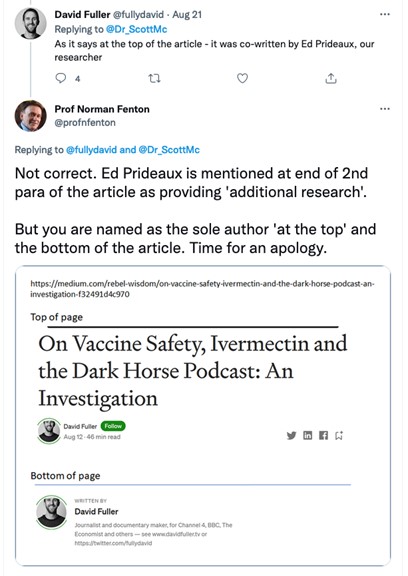
When challenged about authorship Fuller came up
with a remarkable defence. He compounded the false and misleading claims with a
new one claiming someone else co-wrote his article (Fig. 12).
Figure 12:
Fuller claiming an unnamed co-author in the by-line
As countered by Professor Fenton (also Fig. 12),
this claim does not stand up to basic scrutiny. Fuller’s name is the only
name at the masthead and on the by-line as well as the end of the article. He
has therefore taken ownership of, and responsibility for, the entire article.
An article that we have now seen gets many things wrong, and which reports on
investigations he seems to have not ever performed or even read.
Fuller’s attacks
on others
Others who were attacked in Fuller’s article have
spoken about Fuller’s misunderstanding of key documents, events and contexts,
his polemic approach, and the seemingly misleading position he promulgates of
being a truth seeker absent a personal agenda. The prominent
researcher, Dr Pierre Kory,
who was especially attacked in Fuller’s article distributed an email to Fuller with
all those who Fuller targeted in his article. Kory’s email opens with an
expression of astonishment at Fuller’s character attack of him. He goes on to
describe the article as ‘misunderstanding’ academic research work (including the
Peru paper), and implies that Fuller cannot have actually read these works
based on the commentary and conclusions contained in Fuller’s article. This
concurs with Steve Kirsch’s comments shown in Fig.10 where he also points out
that Fuller spent his time researching and attacking the people, rather than
interrogating and critiquing their work.
Fuller asks us in the article to consider
the language being used when reviewing other people’s work, while at
the same time one supposes we are meant to ignore the acrimonious and
disdainful language Fuller himself relies on. Review of many of the articles
Fuller has posted on the rebel Wisdom account show that his SenseMaking
fact checking project is predominately occupied with divisively criticising and
attacking anyone with the temerity to have views Fuller disagrees with. People
calling for further investigation into alternate pharmaceutical treatments to
COVID jabs for those who are symptomatic with COVID have apparently all been infiltrated
by anti-vaxxers.
Further, Fuller’s journalistic style relies heavily on name-calling and
labelling people as scammers,
fascists, reprehensible,
dubious actors,
psychedelics,
ruthlessly corporate,
and conspiracy theorists,
and he admits he created his soapbox in order to be critical of such people.
And, like other prominent journalist fact
checkers, Fuller decries others for speaking out on health matters without
a medical degree (Fig. 13). Yet where is Fuller’s medical degree? Fuller is
himself making pronouncements about what he believes is the right medical
science to follow, and casting aspersions on anyone who has different views -
yet Fuller also appears to lack even basic medical training. At least, as
reported but ignored by Fuller, Kirsch was having these discussions with
someone who was medically trained. Fuller wrote his article with no such expert
input.
Figure 13:
Fuller shooting down others for not having the medical training that he also
lacks
Conclusion
Like many of the other posts fuller has published
on his Rebel Wisdom account, Fuller’s entire article showed predetermination
and a complete unwillingness to consider any of the academic and clinical
research evidence that may exist on either side. The article and the sum of
Fuller’s twitter account shows that he refuses to even consider the possibility
that the vaccines may not be totally safe and effective, or that alternative
treatments may be effective in treating COVID-19.
In
common with many other mainstream journalists there has been a concerted effort
to discredit (and ultimately censor) not just the research of those whose
findings challenge the mainstream narrative, but also the researchers themselves.
Appendix A
While Wakefield clearly reports
that parents (that is, not himself or his research colleagues) anecdotally
associated the onset of behavioural disorders with MMR vaccination, this is not
actually one of his research findings. In fact, in the discussion he
strenuously emphasises the following standalone statement:
We
did not prove an association between measles, mumps and rubella vaccine and the
syndrome described.
In this statement alone he shows that the claim his
paper was retracted for was never actually made in the paper. His paper
does not claim MMR jabs cause autism - in fact it states the opposite quite
clearly. The actual research suggests there may be some relationship between
chronic intestinal inflammation observed in the subject children and the
affective changes in mood, behaviour and neuro-development. Wakefield’s paper
discusses theories about altered digestion and gut absorption, and altered
chemical processes in the intestines. However, and likely because his research
was ‘cancelled’
before he could make the connection, he never fully realises the link between
the inflammation and the other microbial histological findings he observed and
neurological changes that so many present day researchers and clinicians now
know absolutely exists. So in rebuttal, it may be fair to note that Wakefield’s
retracted paper was formative in the gut-brain link research space. Had he been
allowed to continue, and had he succeeded, he would have pre-empted all of the
work I cite in footnote 23.