Monday, 24 December 2018

Bayesian network approach to Drug Economics Decision Making


This is an update of a short paper I first produced in 2014.

Consider the following problem:
A relatively cheap drug (drug A) has been used for many years to treat patients with disease X. The drug is considered quite successful since data reveals that 85% of patients using it have a ‘good outcome’ which means they survive for at least 2 years. The drug is cheap and the overall “financial benefit” of the drug (which assumes a ‘good outcome’ is worth $5000 and is defined as this figure minus the cost) has a mean of $4985.

There is an alternative drug (drug B) that a number of specialists in disease X strongly recommend. However, the data reveals that only 65% of patients using drug B survive for at least 2 years. Moreover, this drug is expensive. The overall “financial benefit” of the drug has a mean of just $2777.
On seeing the data the Health Authority recommends a ban against the use of drug B. Is this a rational decision?

The answer turns out to be no. This short paper explains this using a simple Bayesian network model that you can run (by downloading the free copy of AgenaRisk). Moreover, you can also compute the optimal decision automatically using the Hybrid Influence Diagram tool in AgenaRisk.


Fenton N.E. (2018) "A Bayesian Network and Influence Diagram for a simple example of Drug Economics Decision Making",  DOI: https://doi.org/10.13140/RG.2.2.33659.77600

Thursday, 20 December 2018

Review of “The Book of Why" by Pearl and Mackenzie

Judea Pearl and Dana Mackenzie: “The Book of Why: The New Science of Cause and Effect”, Basic Books, 2018. ISBN: 9780465097609

 www.basicbooks.com/titles/judea-pearl/the-book-of-why/9780465097609/
We have finally completed a detailed review of this important and outstanding book - the review will hopefully be published in the journal Artificial Intelligence. But a preprint of the full review is now available.

Some excerpts from the review:
  • Judea Pearl, a Turing Award prize winner, is a true giant of the field of computer science and artificial intelligence. The Turing award is the highest distinction in computer science; i.e., the Nobel Prize of computing. To say that his new book with Dana Mackenzie is timely is, in our view, an understatement. Coming from somebody of his stature and being written for a general audience (unlike his previous books), means that the concerns we have held about both the limitations of solely data driven approaches to artificial intelligence (AI) and the need for a causal approach, will finally reach a very broad audience.
  • According to Pearl, the state of the art in AI today is merely a ‘souped-up’ version of what machines could already do a generation ago: find hidden regularities in a large set of data. “All the impressive achievements of deep learning amount to just curve fitting”, he said recently. 
  • In Chapter 1, the core message about the need for causal models is underpinned by what Pearl calls “The Ladder of Causation”, which is then used to orient the ideas presented throughout the book. Pearl’s ladder of causation suggests that there are three steps to achieving true AI. .... Pearl also characterises these three steps on the ladder as 1) ‘seeing’; 2) ‘doing’; and 3) ‘imagining’. 
  • One of the reasons ‘deep learning’ has been so successful is that many problems can be solved by optimisation alone without the need to even consider advancing to rungs in the ladder of causation beyond the first. These problems include machine vision and machine listening, natural language processing, robot navigation, as well as other problems that fall within the areas of clustering, pattern recognition and anomaly detection. Big data in these cases is clearly very important and the advances being made using deep learning are undoubtedly impressive, but Pearl convincingly argues that they are not AI.
  • There is much excellent material in this book but, for us, the two key messages are: 1) “True AI” cannot be achieved by data and curve fitting alone, since causal representation of the underlying problems is also required to answer “what-if” questions, and 2) Randomized control trials are not the only ‘valid’ method for determining causal effects.
Norman Fenton, Martin Neil, and Anthony Constantinou, 20 December, 2018

For the full review see:
Review of: Judea Pearl and Dana Mackenzie: “The Book of Why: The New Science of Cause and Effect”, Basic Books, 2018 DOI: https://doi.org/10.13140/RG.2.2.27512.49925, by Norman Fenton, Martin Neil, and Anthony Constantinou

Thursday, 29 November 2018

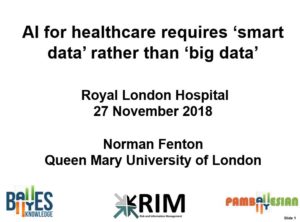
AI for healthcare requires ‘smart data’ rather than ‘big data’

Norman Fenton gave a talk titled AI for healthcare requires ‘smart data’ rather than ‘big data’ to medics at the Royal London Hospital on 27 November. He explained the background and context for the PAMBAYESIAN project.

Norman's Powerpoint presentation

Thursday, 15 November 2018

Book Launch at the Turing Institute

Some photos from last night's book launch event at The Turing Institute

Norman Fenton and Martin Neil


More photos

Tuesday, 13 November 2018

Book Launch event at The Turing Institute

On 14 November 2018 Norman Fenton and Martin Neil are hosting a reception at The Turing Institute to celebrate the launch of the Second Edition of their book "Risk Assessment and Decision Analysis with Bayesian Networks".


Slide show of the book 

A small number of places remain for people to register for the reception

Book Blog

Tuesday, 30 October 2018

Forensic Science in Criminal Justice


Norman Fenton was a contributor to The Turing Institute submission to the House of Lords Science and Technology Committee inquiry into Forensic Science, published on the Parliament website.

Queen Mary News has a nice article summarising the contributions of its staff members.

The Turing Institute summary and full report.


Wednesday, 17 October 2018

Turing Fellows

Proud to announce that five members of the Risk and Information Management Group have been appointed as Fellows of the Turing Institute.  They are: Anthony Constantinou, Norman Fenton, William Marsh, Martin Neil, and Fabrizio Smeraldi. 


The official Turing Institute announcement is here.